What Is a Gentle Spinal Twist Stretch?
A gentle spinal twist stretch is a controlled, rotational movement of the spine performed with minimal force and maximum support. Unlike the aggressive torquing you might see in advanced yoga classes, a gentle twist prioritizes pain-free range of motion over depth. It targets the thoracic and lumbar spine, the muscles along the vertebral column, and the deep stabilizers of the core.
Most people think of a twist as simply turning the upper body while the hips stay fixed. But there's a critical difference between a compressive twist and a decompressive one. A gentle spinal twist uses props and careful alignment to avoid compressing the lumbar discs. The goal is not to see how far you can turn, but to release tension, improve mobility, and reduce back pain.
This stretch is especially valuable for those with stiff spines, acute back pain, or a history of injury. It answers the question "What is spinal twist stretch?" by focusing on the quality of the movement rather than the quantity of rotation.
Why This Stretch Is Different for Sensitive Backs
When I first started working with clients who had chronic low back pain, I made the mistake of assuming a supine twist was universally safe. I learned quickly that without proper support, the twist can aggravate the lumbar spine. The thing nobody tells you is that the lumbar spine has very little rotational capacity - only about 5 degrees of rotation per segment. Most of the twist happens in the thoracic spine. If you force the lumbar spine to twist beyond its natural limit, you strain the discs, facet joints, and ligaments.
So is twisting your spine a good stretch? Yes, but only if you respect your anatomy. A gentle spinal twist is excellent for spinal health because it mobilizes the mid-back, stretches the external obliques, and stimulates the parasympathetic nervous system. However, the same stretch done aggressively can cause harm. The key is to isolate the twist to the upper back while keeping the pelvis stable and the lower back neutral.
For a deeper dive on how to incorporate this into your daily routine, see our guide on How to Start a Gentle Morning Stretch Routine.
Before You Start: Safety Checks and Contraindications
Not everyone should perform a spinal twist, even a gentle one. Here are the absolute contraindications to stop and consult a healthcare provider:
- Osteoporosis or osteopenia - bone density loss increases fracture risk, especially in the vertebrae. A twist can cause a compression fracture.
- Acute disc herniation or bulging disc - twisting can worsen the protrusion, particularly if the disc is already pressing on a nerve root.
- Pregnancy (especially after the first trimester) - hormonal changes loosen ligaments, and the growing belly shifts the center of gravity. Avoid deep twists; gentle side-lying variations are safer.
- Recent spinal surgery or fusion - wait until cleared by your surgeon, usually 6-12 weeks.
- Severe spinal stenosis or spondylolisthesis - twisting may narrow the spinal canal further.
If you experience sharp, shooting, or radiating pain during the stretch, stop immediately. The correct sensation is a gentle pulling or stretching feeling, not a pinch or burn. Listen to your body: if you feel the urge to arch your back or hold your breath, you are likely going too far.
Step-by-Step: How to Do a Gentle Spinal Twist
Here is the most reliable method for a sensitive back. Perform it on a yoga mat or firm carpet. You will need a bolster or a firm rolled blanket (4-6 inches in diameter).
The Prop-Supported Supine Twist
- Lie on your back with your knees bent and feet flat on the floor. Place the bolster lengthwise under your knees. This keeps your lower back in a neutral position and prevents the pelvis from tilting.
- Extend your arms out to the sides at shoulder height, palms up. This opens the chest and gives you a reference for how far you are rotating.
- Inhale deeply. On the exhale, gently guide both knees to the right. Keep your knees stacked and your feet relaxed. Do not let the right knee drop below the left - they should stay together.
- Allow your left shoulder blade to lift slightly off the floor, but do not force it down. The twist should come from the middle of your back, not from your lower spine.
- Turn your head to the left only if it feels comfortable. If your neck is stiff, keep your head centered or place a small pillow under it.
- Hold for 5-8 slow breaths. On each exhale, imagine your spine lengthening as you relax into the twist.
- To exit, inhale to bring the knees back to center. Pause for a breath, then repeat on the other side.
Breathing cues are essential here. As we cover in How to Practice Gentle Breathing for Calm, the exhale is your cue to release tension. Try to make the exhale longer than the inhale - for example, inhale for 4 counts, exhale for 6. This activates the parasympathetic nervous system and allows the muscles to relax more deeply.
Core Engagement to Protect the Lumbar Spine
Most people don't realize that a spinal twist requires active core engagement, not passive relaxation. Before you move your knees, gently draw your belly button toward your spine. Imagine you are hugging a beach ball with your lower abdomen. This creates a stable corset around your lumbar spine, preventing excessive rotation at the L4-L5 and L5-S1 segments. You should feel the twist happening higher up, around the T10-T12 vertebrae.
If you feel any pinching in your lower back, you are likely not engaging your core. Back off the rotation and re-engage the deep abdominals.
Modifications and Progressions
For very stiff backs, acute pain, or limited mobility, you can modify the above stretch in several ways.
Pillow Under Knees
If you do not have a bolster, use two stacked pillows or a folded blanket under your knees. The goal is to keep your hips and knees at a 90-degree angle so that your lower back stays neutral. This is the most important props for a gentle twist.
Limited Rotation
Do not aim for your knees to reach the floor. Instead, rotate only 15-20 degrees. A good cue is to keep your knees within the width of your mat. If your mat is 24 inches wide, your knees should not go beyond the edge. This prevents the pelvis from twisting and takes the strain off the sacroiliac joint.
Seated Variation
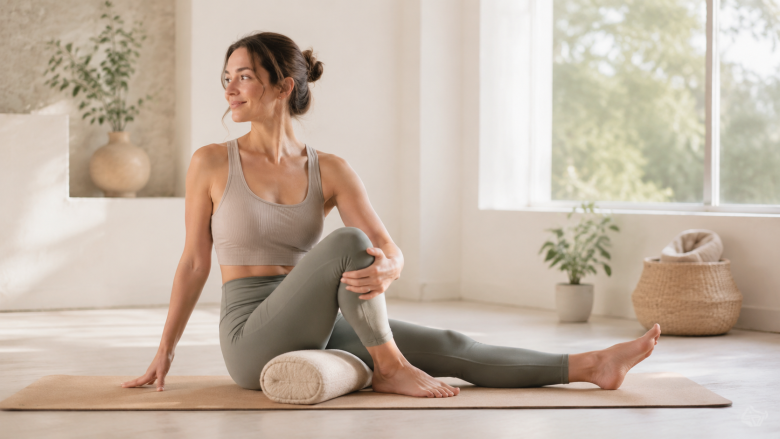
If lying down is uncomfortable (e.g., during pregnancy or after a recent injury), try a seated twist on a chair. Sit tall with your feet flat on the floor. Place your hands on your thighs. Inhale to lengthen your spine, exhale to gently turn your upper body to the right, using your left hand on your right knee for support. Keep your hips facing forward. This variation limits the range of motion and is very safe.
Progression: From Bolster to Full Supine Twist
Once you can hold the prop-supported version for 8 breaths without discomfort, you can try removing the bolster. Lie on your back with knees bent and feet flat. Still engage your core. Guide your knees to one side, but this time allow them to lower a bit further. Keep both shoulders on the floor if possible. If one shoulder lifts, reduce the rotation. Over 2-4 weeks, your range of motion will naturally increase without forcing.
I always tell my clients: a gentle twist that feels like a 3 out of 10 on the intensity scale is far more effective than a deep twist that feels like a 7. Consistency beats intensity.
Common Mistakes and How to Avoid Them
- Over-twisting: Trying to get your knees to the floor is the most common error. Your knees should rest at a height that keeps your pelvis stable. If you feel your hips lifting or your lower back arching, you have gone too far.
- Holding your breath: Many people instinctively hold their breath when they feel a stretch. This tightens the core and prevents relaxation. Use the breath as a guide - if you cannot breathe deeply, back off the twist.
- Lack of core support: Without core engagement, the twist compresses the lumbar discs. Always activate the transverse abdominis before moving.
- Neck strain: Turning the head too far can strain the cervical spine. If you feel a pinch in your neck, keep your head centered or support it with a small towel.
If you are looking for additional gentle stretches to complement this twist, our article on 10 Gentle Stretches to Ease Tension has several options that pair well with the spinal twist.
A Progressive Plan for Your Stiff Spine
Here is a simple framework to build your gentle spinal twist practice over 4 weeks. Perform this 3-4 times per week, ideally after a warm-up like a light walk or a warm bath.
| Week | Stretch Variation | Hold Time | Reps per Side |
|---|---|---|---|
| 1 | Prop-supported (bolster under knees), limited rotation (knees within mat width) | 5 breaths | 2 |
| 2 | Same, but increase rotation slightly (knees halfway to floor) | 6 breaths | 2 |
| 3 | Remove bolster, but place a pillow under the knees if needed | 7 breaths | 3 |
| 4 | Full supine twist (no knee support) with core engagement, knees at comfortable height | 8 breaths | 3 |
If at any point you feel pain, return to the previous week's variation. There is no rush. The goal is to improve mobility without provoking pain.
Are Spinal Twists Good for Back Pain?
Yes, when done correctly, spinal twists can help relieve back pain by improving spinal mobility, reducing muscle tension, and promoting blood flow to the paraspinal muscles. However, they are not a cure-all. For many people with chronic low back pain, the root cause is weak glutes, tight hip flexors, or poor posture. A gentle spinal twist should be one part of a comprehensive approach that includes stretching the hips, strengthening the core, and improving daily movement patterns.
If you are dealing with acute back pain, especially if it radiates down your leg, consult a physical therapist before attempting any twist. The gentle approach described here is designed for sensitive backs, but it is not a substitute for professional medical advice.
I have seen clients who were terrified of twisting because they had been told it was dangerous. In reality, a carefully supported twist can be a gateway to pain-free movement. The most important thing is to start small, use props, and listen to your body's signals. Over time, you will feel a new sense of freedom in your spine.