What You Really Need to Know About Leg Raises and Your Lower Belly
If you've ever searched for "leg raises exercise for lower belly," you've probably seen videos promising a flat stomach in 30 days. I've been there too. When I first started training, I'd crank out 50 leg raises every night, convinced my lower belly would finally vanish. Spoiler: it didn't. That's because leg raises, as most people do them, are a hip-flexor dominant movement, not a lower-ab exercise. The real secret to targeting the lower belly lies in how you set your pelvis, control your breathing, and coordinate your deep core muscles. This article will show you the exact mechanics, common mistakes, and a 10-minute progression plan that actually works.
The Real Reason Your Lower Belly Bulges
Before we talk about exercises, let's address the elephant in the room: lower belly bulge isn't just about fat. Most people don't realize that poor posture, chronic bloating, and a weak deep core (transversus abdominis) can create a protruding lower belly even if you're lean. When your pelvis tilts forward (anterior pelvic tilt), your lower abdominal wall stretches and weakens, pushing your belly out. Leg raises without correcting that tilt only reinforce the problem.
I've seen clients who could do 50 leg raises without any lower-ab engagement. Their hip flexors did all the work, and their lower back arched off the floor. That's a one-way ticket to back pain, not a flat stomach. The thing nobody tells you about leg raises is that they're a test of your ability to stabilize your pelvis, not a shortcut to lower belly tone.
Do Leg Raises Help With Lower Stomach?
Yes, but only if you perform them with a posterior pelvic tilt and engage your deep core. Without that, you're training your hip flexors (the psoas and rectus femoris) to pull on your lower spine, which can actually worsen the appearance of a lower belly pooch by encouraging more lumbar extension. The key is to flatten your lower back against the floor before you lift your legs, and keep it pressed down throughout the entire movement.
Most people skip this step because it feels awkward and requires more effort. But that's exactly where the magic happens. When I first learned to tuck my pelvis properly, I could barely lift my legs 6 inches off the floor without my lower back peeling up. That's a sign that your deep core is working, not your hip flexors.
How to Leg Raise for Lower Abs
Here's the step-by-step form correction that most online videos leave out:
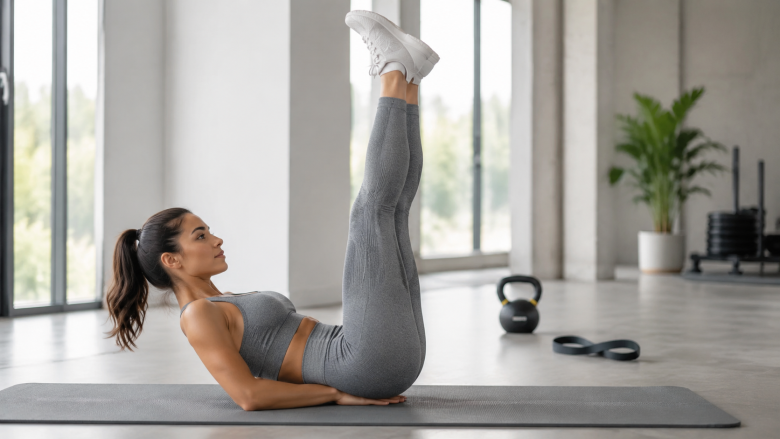
- Start on your back with legs straight, arms by your sides (palms down for leverage). Press your entire lower back into the floor. If you can't feel your lower back touching, squeeze your glutes slightly and tuck your tailbone under.
- Inhale deeply. As you exhale, brace your core as if someone is about to punch you in the stomach. This engages your transversus abdominis.
- Keep your lower back glued to the floor as you slowly lift both legs to about 45 degrees (or until you feel your lower back start to lift). Stop well before that point.
- Pause for 2 seconds at the top, then lower with control over 3-4 seconds. Don't let your legs drop. If you can't control the descent, you're lifting too high.
Most people can only lift their legs 30-45 degrees off the floor without losing pelvic neutral. That's normal. The goal is not to touch your toes to the ceiling; it's to maintain tension in your lower abs throughout the full range of motion. If you feel a pull in your hip flexors or lower back, you've gone too far.
The Biggest Mistake: Hip-Flexor Dominance
I once worked with a runner who complained of chronic lower-back tightness after doing leg raises. I watched her lift her legs to 90 degrees, her back arched like a bridge. She was using her hip flexors to yank her legs up, and her lower abs never engaged. We regressed to bent-knee raises (knees at 90 degrees) and focused on exhaling while pressing her lower back down. Within two weeks, her back pain vanished and she could feel her lower belly working for the first time.
That's the trade-off: leg raises that look impressive (straight legs, high range) are often useless for your lower belly. The more you flex your hip, the more your psoas tightens and pulls on your lumbar spine. To target the lower abs, you need to limit the range of motion and prioritize pelvic control. This is why many physical therapists recommend keeping the legs bent or performing knee raises before attempting straight-leg raises.
How Do I Flatten My Lower Belly Pooch?
Flattening the lower belly pooch requires a combination of three things: (1) correcting your posture to reduce anterior pelvic tilt, (2) strengthening your deep core with anti-extension exercises, and (3) managing bloat through breathing and diet. Leg raises alone won't do it. You need to pair them with exercises like dead bugs, hollow holds, and glute bridges that teach your body to stabilize the pelvis.
Let me share a framework I call the "Pelvic Reset":
- Step 1: Release tight hip flexors with a half-kneeling stretch (30 seconds per side).
- Step 2: Activate your glutes with glute bridges (2 sets of 15 reps).
- Step 3: Perform posterior pelvic tilts on your back (10 reps, holding for 5 seconds each).
- Step 4: Do dead bugs (3 sets of 10 reps per side) to teach anti-extension control.
- Step 5: Add leg raises only after you can maintain a neutral pelvis during dead bugs.
This sequence addresses the root cause of the lower belly bulge: a weak pelvic floor and overactive hip flexors. Most people skip the release and activation steps, then wonder why their leg raises don't work.
Breathing: The Missing Piece
When I first started doing leg raises, I held my breath. That's a common mistake. Holding your breath increases intra-abdominal pressure and can push your belly out, especially if you're bloated. Instead, practice "360-degree breathing" - inhale deeply into your sides and back, then exhale fully while drawing your navel toward your spine. This engages the transversus abdominis, which acts like a corset for your lower belly.
Try this: before you lift your legs, exhale completely and then hold that tightness. Lift your legs only 2 inches off the floor and hold for 5 seconds while breathing shallowly. If you can maintain the lower back contact, you're using your deep core. If you have to arch your back to breathe, your core isn't firing.
Regressions and Progressions: A 10-Minute Plan
Here's a progression plan I've used with dozens of clients, from beginners to advanced. Perform each step for 2 minutes, resting 30 seconds between steps. Total time: 10 minutes.
- Step 1: Pelvic tilts (regression). Lie on your back with knees bent, feet flat. Exhale and press your lower back into the floor. Hold for 5 seconds, then release. Focus on feeling the movement in your lower abs, not your hip flexors.
- Step 2: Bent-knee leg raises. Keep knees bent at 90 degrees. Lift your thighs until they are parallel to the floor, keeping your lower back down. Lower slowly. This reduces hip-flexor leverage.
- Step 3: Single-leg lowers (anti-extension). Start with both legs in tabletop (knees bent 90 degrees, shins parallel to floor). Slowly lower one foot to the floor, keeping your back flat. Return to start. Repeat on the other side.
- Step 4: Straight-leg raises (partial range). Only lift your legs to 30 degrees off the floor. If your lower back lifts, lower the range. Aim for 2 controlled seconds up, 3 seconds down.
- Step 5: Full-range leg raises (advanced). Only if you can maintain a neutral pelvis through the previous 4 steps. Lift to 45 degrees and pause.
I've seen beginners who couldn't do Step 2 without back arching. After 2 weeks of daily pelvic tilts and dead bugs, they could do Step 4 with perfect form. Progress is slower than most people want, but it's sustainable.
What Exercises for Lower Tummy? (Beyond Leg Raises)
Leg raises are one piece of the puzzle, but they're not the most effective. Here are three exercises that directly target the lower belly by forcing your deep core to resist spinal extension:
- Dead bugs: Lie on your back with arms extended toward the ceiling, knees bent at 90 degrees. Simultaneously lower your right arm overhead and left leg toward the floor, keeping your lower back pressed down. Return and switch sides. This teaches your core to stabilize against rotation and extension.
- Hollow-body holds: Lie on your back, press your lower back into the floor, and lift your shoulders and legs off the ground. Hold for 20-30 seconds. This is a direct test of your ability to maintain a posterior pelvic tilt under load.
- Reverse crunches: Similar to leg raises but with a crunch motion. Start with legs in tabletop, then lift your hips off the floor by curling your pelvis toward your ribcage. This targets the lower rectus abdominis more directly than leg raises.
For a deeper dive on how many calories you might be burning during these exercises, check out our Exercise Calories Per Hour Calculator. It can help you estimate the energy expenditure of different core moves, though remember that spot reduction is a myth - you can't target fat loss from just your lower belly.
Common Mistakes That Sabotage Your Results
I've made every mistake in the book, and I've seen clients repeat them. Here are the top three:
- Mistake 1: Lifting legs too high. The higher you lift, the more your hip flexors take over. Stop at 45 degrees max, or even 20 degrees if you feel your back arching.
- Mistake 2: Holding your breath. This builds pressure in your abdomen and can make your lower belly bulge more. Exhale on the effort (lifting) and inhale on the lowering phase.
- Mistake 3: Using momentum. Swinging your legs up from momentum means your core never has to work. Lower slowly, under control, and pause at the top.
One more thing nobody tells you: if you have tight hamstrings, straight-leg leg raises can be painful and ineffective. Try bending your knees slightly at the start to reduce hamstring tension. I've had clients who couldn't even touch their toes due to tightness - they needed to start with bent-knee variations and incorporate hamstring stretches before seeing progress.
The Science of Anti-Extension Work
Your lower abs are primarily responsible for preventing your spine from extending (arching backward). This is called "anti-extension" core stability. Leg raises, dead bugs, and hollow holds all fall into this category. The problem is that most people do leg raises with an arched back, which turns the movement into a hip-flexor exercise, not an anti-extension one.
To make leg raises anti-extension, you must maintain a posterior pelvic tilt throughout. This is not intuitive. I remember the first time I tried it - my abs shook after 3 reps. That's a sign of deep core engagement. If you're not feeling the burn in your lower belly, you're likely not doing it right.
For a practical tool to estimate the calories burned during a 45-minute leg raise session (or any leg exercise), try our Leg Calories Per 45 Minutes Calculator. It's useful for tracking overall energy expenditure, but remember that core strength, not calorie burn, is what creates a flatter lower belly appearance.
How to Combine Leg Raises With Other Lower-Belly Work
Here's a sample 15-minute routine that I've used with clients to see real results in 4-6 weeks:
- 0-3 min: Pelvic tilts (10 reps with 5-second holds) + deep breathing (360-degree breaths).
- 3-6 min: Dead bugs (3 sets of 10 per side).
- 6-9 min: Bent-knee leg raises (3 sets of 12 reps).
- 9-12 min: Straight-leg leg raises (partial range, 3 sets of 8 reps, focusing on form).
- 12-15 min: Glute bridges (2 sets of 15 reps) + hamstring stretch (30 seconds each side).
Perform this routine 4-5 times per week, but listen to your body. If you feel pain in your lower back, regress to bent-knee raises or reduce the range of motion. The goal is to feel the lower belly working, not to push through discomfort.
Honest Limitations: What Leg Raises Can't Do
Leg raises will not spot-reduce lower belly fat. No exercise can do that. I've seen incredibly strong people with visible six-packs still have a slight lower belly pooch, especially if they have poor posture or bloating. Fat loss is systemic - you achieve a flat stomach through a caloric deficit, not through targeting a specific area.
However, leg raises can improve the appearance of your lower belly by strengthening the deep core, which pulls the abdominal wall inward. That's a structural change, not a fat-loss one. Combined with good posture, reduced bloating, and a healthy diet, you'll see a difference. But if you're expecting to lose 10 pounds of belly fat from leg raises alone, you'll be disappointed.
Trade-offs: Leg raises are not suitable for everyone. People with lower-back issues, herniated discs, or hip impingement should avoid them or only perform them under supervision. If you have a history of back pain, start with dead bugs and pelvic tilts instead. Always consult a physical therapist or doctor before starting a new exercise program.
Final Thoughts: The Path to a Stronger, Flatter Lower Belly
Leg raises can be a powerful tool for your lower belly, but only if you approach them with the right technique and expectations. The secret is not in the height of the lift, but in the control of your pelvis. Master the posterior pelvic tilt, breathe deeply, and integrate anti-extension exercises like dead bugs into your routine. With consistent practice, you'll feel your lower abs working for the first time, and you'll see a visible change in the way your lower belly looks and functions.
If you're just starting out, be patient. I couldn't do a proper leg raise for weeks after I learned the correct form. But once I got it, the progress was steady. Use the 10-minute progression plan above, track your form, and don't skip the basics. Your lower belly will thank you.